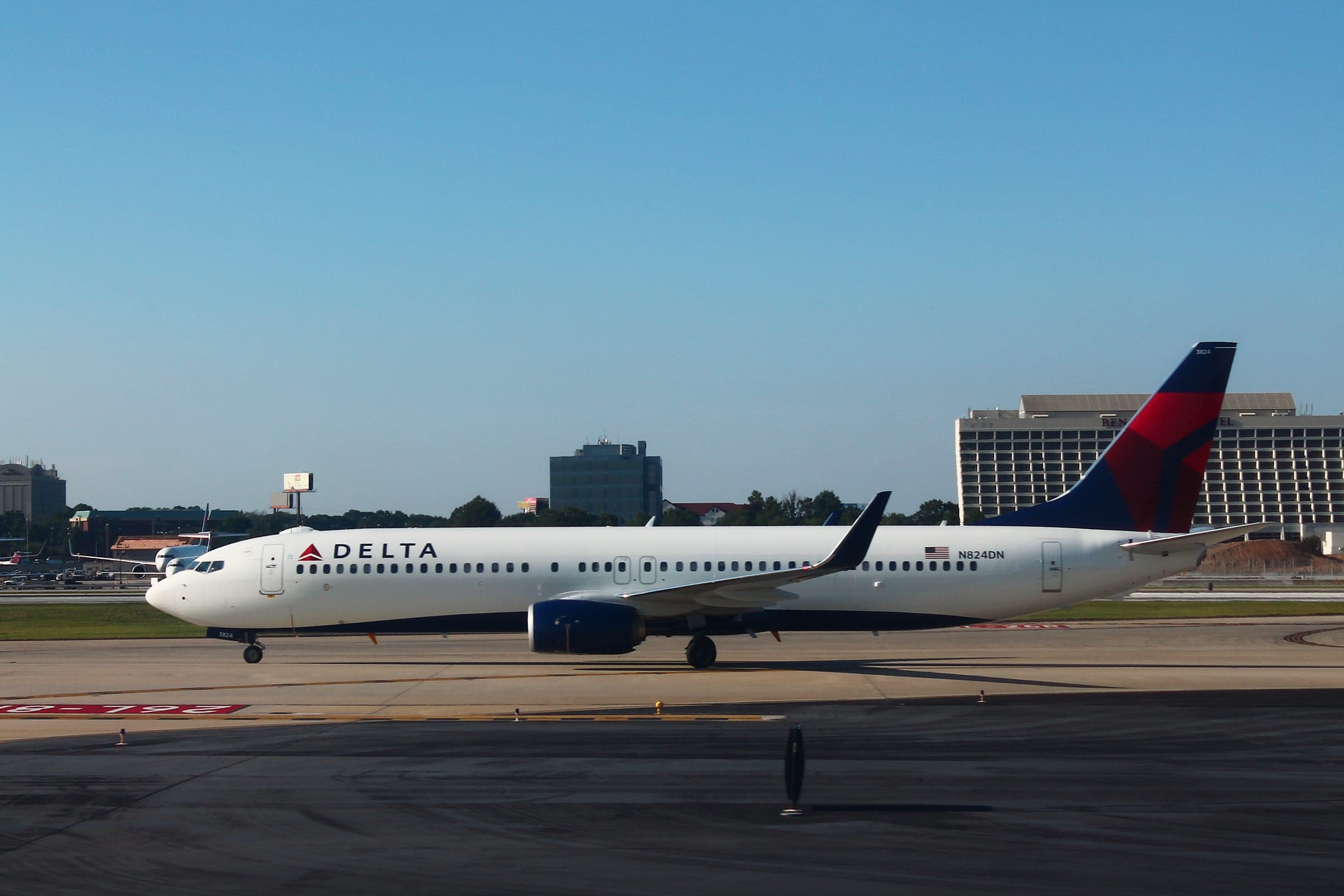
Delta's first nonstop between the US and Saudi Arabia launched this week, and Riyadh Air has put out 18 pilot vacancies in a fortnight on our own platform. Those two facts sit closer together than they look. Every Gulf carrier writing an expat pilot package in 2026 is pricing against a US pay scale that has moved more in three years than in the previous twenty, and that has now converged so tightly at the top that a pilot choosing between Delta, United and American is choosing on base and fleet, not money.
For anyone in the region weighing a US-registered career, holding a US passport, or negotiating against a recruiter who quotes "Delta money" as a ceiling, here is what the numbers actually are, where they come from, and where the published figures contradict each other.
The two numbers that define a US pilot's paycheque
US mainline pay is built on an hourly rate multiplied by credited hours, not a salary. Two variables matter:
The hourly rate. Set by a grid in the collective bargaining agreement with two axes: year of longevity with the airline, and aircraft pay category. Nothing else. A 20,000-hour ex-Emirates A380 captain hired at United starts on the same year-one first officer rate as a 1,500-hour graduate from a regional. Seniority does not transfer between airlines, which is the single most expensive fact in the profession.
The monthly guarantee. A floor of credited hours paid whether or not the pilot flies them. United's is documented at 73 hours per month in ready-for-takeoff's UPA summary and at 70 hours in Thrust Flight's breakdown of the same contract, a discrepancy worth knowing about because at $465 an hour those three hours are roughly $16,700 a year.
Credited hours are not block hours. Duty rigs, trip rigs, minimum day guarantees, deadhead pay and cancellation pay all convert time on the road into paid hours, and a pilot flying 65 actual block hours can easily be credited 85. On top sit per diem (United pays roughly $3.00 an hour domestically), holiday pay, override pay for premium trips, and open-time pickups at 150 percent or better. Then profit sharing, which at Delta and United runs 10 percent of profits up to $2.5bn and 20 percent above that, and direct retirement contributions: 16 percent at United under PRAP, 18 percent non-elective plus a 2 percent cash balance plan at Southwest in 2026.
Hourly rate is therefore the wrong number to quote and the only one anyone publishes. Total compensation typically runs 25 to 40 percent above rate-times-guarantee.
What the 2023 and 2024 contracts actually did
The post-pandemic pilot shortage produced four agreements in fifteen months, each one leapfrogging the last:
- Delta, ratified early 2023: 18 percent on signing, then annual increases of 4 to 5 percent through 2026. Aviation A2Z puts the cost at $7.2bn over four years.
- United, ratified September 2023 after a 99 percent strike authorisation vote: approximately $10.2bn over four years, immediate increases of 13.8 to 18.7 percent (14.1 percent on the 777 and 787, 18.7 percent on the 737-700 and A319), roughly 40 percent cumulative with step-ups running into 2027. Also $1.2bn of back pay recapture covering 4 percent of 2020 and 2021 earnings and 14 percent of 2022 and 2023 earnings.
- American, shortly after United, explicitly matching United's scales.
- Southwest, January 2024: a five-year, $12bn deal through the end of 2028 with 29.15 percent on signing, 4 percent in each of 2025, 2026 and 2027, and 3.25 percent in 2028, per One Mile at a Time's contract summary.
Delta's contract contains a snap-up clause guaranteeing industry-leading rates, which is why its scales ticked up 1 percent when United's deal landed. That mechanism has now run out of room: Delta's agreement expires this year, its pilots opened a public campaign for a new one in April 2026, and the argument they are making is arithmetic. Delta has reported more than $18bn in pretax income across the four years the contract covered.
Where the Big Three sit in 2026
| Fleet / seat | Delta | American | United | Southwest |
|---|---|---|---|---|
| Widebody captain, yr 12 (777/787/A350) | $465.13/hr | $417.07/hr (rising) | $417.07/hr (rising) | n/a |
| Widebody FO, yr 12 | $317.73/hr | $284.86/hr (rising) | $284.86/hr (rising) | n/a |
| 737 captain, current | $388.27/hr | $402.01 from 2027 | $399.92 from 2027 | ~$364/hr TFP equivalent |
| Narrowbody FO, yr 1 | $125.52/hr | ~$116/hr band | $116/hr (737) | contract minimum |
| Narrowbody FO, yr 2 | step-up | step-up | $177/hr (737) | step-up |
Rates as reported by Aviation A2Z (April and June 2026), Thrust Flight (April 2026) and Simple Flying (July 2026).
The year-one to year-two jump at United, $116 to $177 an hour on the 737, is the steepest single step on the ladder and the reason first-year pay is a genuinely misleading indicator of a major airline career.
The conflict: has the top of the scale converged or not?
This is the disagreement that matters most, and averaging it would be useless.
MigFlug's June 2026 analysis states flatly that a year-12 widebody captain at United, American and Delta all earn $465.13 an hour, describing the Big Three as realigned on a single curve. Aviation A2Z's April 2026 piece uses the same $465.13 figure for Delta but puts American and United at $417.07 for captains and $284.86 for first officers, with their increases landing the following year under their own contracts. Simple Flying, reporting in January 2026 on a leaked American paycheque, put American's widebody top at roughly $447 an hour.
Three credible secondary outlets, three different answers, spread of nearly $50 an hour, which is about $45,000 a year of credited flying. None of them is the contract. The reconcilable reading is that Delta reached $465.13 first through its snap-up and 2026 step, American and American's matched scales arrive there on a 2026 or 2027 effective date, and the outlets are quoting different effective dates as "now". A pilot making a career decision on this should pull the actual pay tables from the ALPA MEC or APA websites rather than trust any of the three, including us.
The most reliable single data point in the whole field is not a scale at all. It is the American Airlines 737 captain in Miami who published a 2025 total of $457,894.51 at an hourly rate above $360, reported by Simple Flying in January 2026. That is a narrowbody captain, not a widebody one, earning inside the widebody band by picking up flying. It tells you more about how US pay works than any grid does.
Southwest is a different machine
Southwest does not pay block hours. It pays Trip For Pay, where one TFP equals a 243-mile segment, with an additional 10 percent for every 40 miles beyond that. Pilots must be credited a minimum of 89 segments in a 31-day month, 87 in a 28 or 29-day month. One Mile at a Time's conversion factor is 1.149: multiply the TFP rate to get a rough hourly equivalent.
The structural effect is that short, fast turns pay better than long sectors, which is why a Southwest captain flying five legs a day out of Dallas can out-earn a peer on the same nominal rate elsewhere. Simple Flying put year-12 first officers at roughly $255 an hour equivalent and senior captains near $364 in 2026, with total compensation above $450,000 once the 18 percent retirement contribution and profit sharing land. A separate Simple Flying analysis has senior Southwest FOs at $296 and captains at $423 by 2028, consistent with the contract's remaining step-ups. For a narrowbody-only operator, that is remarkable, and it is the number Gulf low-cost carriers such as flynas and flyadeal are competing against for US-qualified crew.
The regional rung, honestly
Regional first officer pay rose roughly twofold between 2021 and 2023 as Envoy, Piedmont, PSA, Endeavor and SkyWest fought over a shrinking pool of 1,500-hour candidates, with signing and retention bonuses layered on top of scale to the point where the bonuses often exceeded the base. Flow-through agreements to the mainline parent became the real currency.
We could not verify current 2026 regional pay tables against a live source in this reporting cycle, so we are not publishing a figure we cannot stand behind. Treat any regional number you see quoted this year as needing a check against the carrier's own recruiting page and Airline Pilot Central, and read the bonus structure and flow agreement before the hourly rate.
Realistic total compensation, rung by rung
| Rung | Basis | Realistic total comp | Confidence |
|---|---|---|---|
| Year-1 major FO, narrowbody | $116–125.52/hr on 70–73 hr guarantee | $100,000–125,000 | High |
| Year-2 major FO, narrowbody | $177/hr (United 737) | $150,000–175,000 | Medium |
| Year-12 FO, narrowbody | ~$255/hr (Southwest) | $260,000–300,000 | Medium |
| Year-12 FO, widebody | $284.86–317.73/hr | $270,000–340,000 | Medium |
| Narrowbody captain, mid-career | $388–402/hr | $370,000–460,000 | High |
| Senior widebody captain, yr 12+ | $465.13/hr, ~900 hr/yr | $420,000–470,000 base, above $500,000 all-in | Medium |
MigFlug's model assumes about 80 flight hours a month and 900 credited hours a year including reserve and training pay, which produces the $420,000 to $470,000 base band. Aviation A2Z's June 2026 piece quotes Delta captains at $320,000 to $620,000 and first officers at $120,000 to $235,000. The $620,000 top end is not supported by rate-times-hours arithmetic on any published scale and should be read as a maximum-effort year with heavy premium flying and a strong profit-sharing payout, not a norm.
What this means from Dubai, Doha or Riyadh
A senior Gulf widebody captain package is tax-free, housing-assisted and typically quoted as a total monthly figure. A senior US widebody captain is on a taxed, unit-priced scale with profit sharing, a 16 to 18 percent retirement contribution and a seniority number that cannot be moved. The comparison turns on how much a pilot values portability and predictability against gross number. What has changed since 2023 is that the US top end is now high enough that Riyadh Air and Etihad recruiters can no longer win a US-qualified captain on cash alone, and both are visibly competing on fleet age, command timelines and basing instead.
Methodology and confidence
No US airline publishes pilot pay tables publicly. The scales in this piece are aggregated from secondary reporting of the ratified 2023 Delta and United agreements, American's matching deal and the January 2024 SWAPA contract: Aviation A2Z (April and June 2026), MigFlug (June 2026), Simple Flying (January, June and July 2026), One Mile at a Time's contract summaries (2023 and 2024), Thrust Flight and ready-for-takeoff. Airline Pilot Central sits behind several of these as the common source, which means apparent agreement between outlets is sometimes a single origin repeated.
Firmest: contract structure, ratification dates and percentage increases, all reported consistently across sources. Firm: narrowbody captain rates and first-year FO rates. Softer: the exact current widebody top rate at American and United, where sources disagree by up to $48 an hour, and the monthly guarantee at United, quoted as both 70 and 73 hours. Softest: total compensation ranges, which depend on individual credited hours and profit sharing, and the regional tier, where we declined to publish. Verify against the ALPA, APA or SWAPA pay tables before signing anything.